
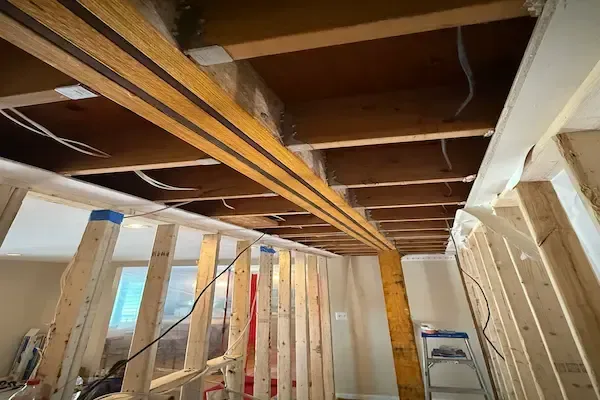
What Homeowners Need to Know Before Removing a Load-Bearing Wall
Before the First Swing: Why Removing a Load-Bearing Wall Starts With Proper Engineering
If you're planning to open up your floor plan — or you've just discovered your contractor removed a wall they shouldn't have — this page is for you.
Load-bearing wall removal is one of the most requested structural projects in Northern Virginia, and one of the most commonly mishandled. Homes in Fairfax, McLean, Vienna, Arlington, and Reston were largely built between the 1950s and 1980s with closed-off floor plans that made sense then and feel cramped now. Removing the right wall with the right beam can transform how a home lives. Removing the wrong wall, or the right wall the wrong way, can compromise the structural integrity of the entire house.
Here's what you need to know.
How Do You Know If a Wall Is Load-Bearing?
This is the most common question homeowners ask — and the most dangerous one to answer without a structural evaluation.
There are general rules of thumb contractors use: walls that run perpendicular to floor joists tend to carry load; walls that run parallel often don't. Center walls on the main floor are frequently load-bearing. Walls stacked directly above one another on multiple floors often transfer load through the structure down to the foundation.
But rules of thumb fail constantly. Northern Virginia's housing stock is full of additions, renovations, and modifications done over five or six decades — often without permits, often without documentation. What looks like a simple partition wall may be carrying the load from a dormer added in 1987. What looks like a structural wall may have been relieved of duty by a previous renovation. You cannot know from looking.
The correct answer is: a licensed structural engineer looks at your framing, reviews the load path from roof to foundation, and makes a determination based on what's actually there — not what should be there based on the original plans.
At HandyMensch, every structural project begins with a structural evaluation. There is no guessing.
---
What Happens When a Contractor Removes a Wall Without Proper Engineering?
We get these calls. A homeowner hired someone who seemed confident. The wall came down. Now the ceiling is cracking, a door won't close, the floor above is bouncing, or — worst case — something shifted visibly. They need someone to fix it.
When a load-bearing wall is removed without proper engineering and a correctly sized beam, the load it was carrying has to go somewhere. It doesn't disappear. It redistributes — unevenly, unpredictably — into adjacent framing, connections, and supports that were never designed to handle it. The damage can appear immediately or develop over months as wood compresses and connections loosen.
Fixing a botched structural removal is significantly more expensive than doing it right the first time. We typically have to: assess the full damage, design a proper engineered solution, open walls or ceilings to access affected framing, install the correct beam and supports, and rebuild everything that was disturbed such as flooring and kitchen cabinets. We also have to pull permits and have the work inspected at different points in the project.
In Fairfax County and throughout Northern Virginia, structural work requires permits. Period. Any contractor who tells you they can remove a load-bearing wall without permits is telling you they plan to do work that can't pass inspection — because it won't.
---
What Does a Proper Load-Bearing Wall Removal Actually Involve?
When HandyMensch handles a load-bearing wall removal, this is what happens:
Engineering first. A licensed structural engineer assesses the load path and specifies the beam — size, material, and connection details. Not every opening requires one. Building code allows prescriptive beam designs for smaller openings — enlarging a window or adding a single door, for example. In those cases we can use code span tables to calculate the beam size and submit directly with our permit plans, which saves time and cost. For anything larger — a wall removal, a significant span, or any situation where the load path isn't straightforward — a structural engineer is the right call. We make that determination during the design phase, not after the wall is open.
Temporary support. Before the wall comes out, temporary walls or posts carry the load above. This is not optional. Skipping this step is one of the most common ways structural removals go wrong.
Permits pulled. We handle all permitting with Fairfax County or the relevant jurisdiction. An inspector will review the work.
The wall comes out. The beam goes in, properly supported at each end by posts or columns that transfer the load down through the floor system to the foundation. In older Northern Virginia homes, we often find that adding a point load requires footer work in the basement — the existing footer isn't sized for the new concentration of weight.
Inspection and close-out. The county inspects. Work is documented. You have a permitted, engineered record of what was done — which matters when you sell.
The whole process — from engineering through final inspection — typically runs about eight to twelve weeks depending on complexity and permit timelines in your jurisdiction.
---
If you're planning a floor plan change in Fairfax, McLean, Vienna, Reston, Arlington, Great Falls, Falls Church, Herndon, or anywhere in Northern Virginia, or if you've inherited a structural problem from a previous contractor, we're the people to call.