
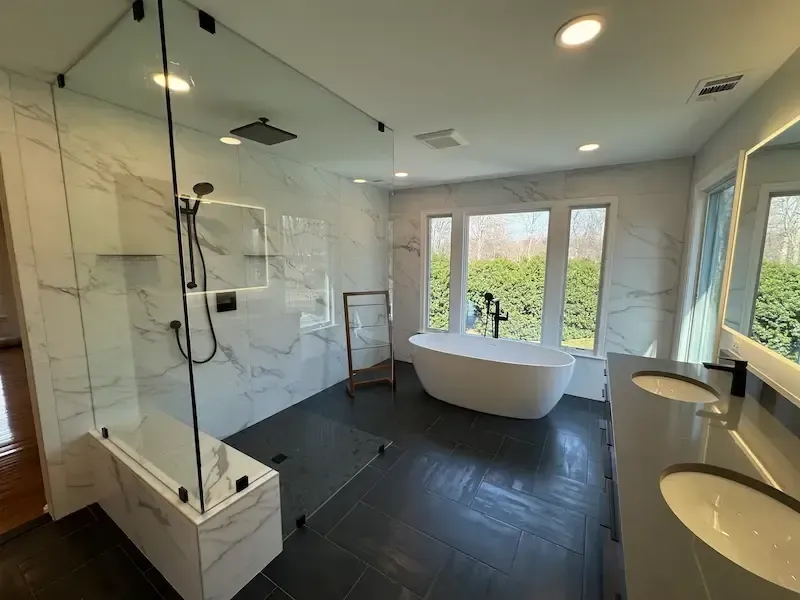
Can I add a bathroom? Let's talk Plumbing
Adding a Bathroom in your Home: Why Plumbing has to be part of the Design Conversation.
Adding a bathroom sounds straightforward until you're three weeks into design and find out the drain stack has to run through the middle of your living room ceiling. That's not a hypothetical — it's a conversation we have with homeowners in Fairfax, McLean, Vienna, Arlington, and Reston regularly. A bathroom addition touches plumbing, structure, electrical, and permits simultaneously. Done right, it adds significant value to your home. Done without the right expertise from the start, it creates expensive problems mid-project.
Why Plumbing Has to Be Part of the Design Conversation From Day One
Most homeowners start with their own ideas — a sketch, a Pinterest board, or a layout generated with an AI tool. That's fine. But if a licensed plumber isn't part of the design discussion early, you risk a beautiful layout that's physically impossible to build without tearing apart finished spaces you didn't plan to touch.
Every fixture requires a drain that ties into your home's main stack. Where that stack is located determines what's feasible. Moving fixtures far from the stack means longer drain runs, more slope required, and more ceiling depth consumed in the floor below. There are structural considerations for running plumbing since there are limits to the size and placement of holes in beams and joists. At HandyMensch, a licensed plumber is involved in the design phase — not called in after the layout is finalized.
How Your Home's Plumbing Works — The Basics
The stack. A main vertical pipe runs from the basement through the house and exits through the roof. Every drain — toilets, sinks, showers, tubs — connects to it. Wastewater flows down by gravity and out to the sewer or septic. The stack also vents sewer gases through the roof.
Drain lines and slope. Drains rely entirely on gravity — every horizontal line must slope 1/4 inch per foot toward the stack. The farther a fixture is from the stack, the more slope needed, and the more ceiling depth consumed getting there.
Groundworks. Drain and supply lines that run underground — below a basement slab or below grade. The most labor-intensive part of a basement bathroom addition because they require cutting concrete, excavating, rough-plumbing, inspection, and slab restoration.
Supply lines. Pressurized hot and cold water delivered to fixtures. Three of the most common materials you'll encounter in Northern Virginia homes:
Copper — standard before the 1990s, durable but expensive today. Older copper develops mineral buildup and pinhole leaks.
PEX — the modern standard. Flexible, freeze-resistant, doesn't corrode. We use it extensively for new supply lines.
CPVC — Plastic pipe found in some 1980s–2000s homes. We'll make minor modifications or convert to PEX where it makes sense.
Note: The regular white PVC is drain pipe only — it can't handle supply pressure.
Adding a Basement Bathroom
Basement drains sit below the main stack, so gravity drainage requires cutting the concrete slab. We want the new bathroom as close to the main drain as possible to minimize pipe distance and slope.
Slab cutting and excavation. We cut and excavate to depth, rough-plumb the drain lines underground, then restore the slab after inspection.
Stack tie-in. New drains connect past the main fixture group — not into a nearby sink drain. Older homes frequently have cast iron drain lines; we replace full sections rather than splice new PVC into old cast iron.
Inspections. Multiple inspections are required. Groundworks are inspected before the slab closes. Rough-in inspection approves everything behind walls before they're closed. A shower pan test is required before tile if there's a shower. Final inspection closes the permit. Permits and inspections protect you by having an independent person that works for the County confirm the work is done correctly. It also insures that a licensed plumber performed the work.
Adding or Relocating a Bathroom on an Upper Floor
No slab cutting, but potentially significant work in floor and wall cavities.
Drain routing. Drains travel down through floor joists to reach the stack. Depending on stack location, this may require opening ceilings on the floor below — the scenario where a layout that looks great on paper ends up running pipe through a finished living room ceiling.
Structural considerations. Slope and size of the drain pipe must be considered if there are joists and beams on the path. A freestanding tub adds concentrated weight a floor system may not be designed for. When required, we evaluate joist size, span, and condition before finalizing any upper floor layout. Sistering joists or adding support is sometimes required.
Powder room to full bathroom. Adding a shower or tub drain means opening the floor and running new lines. Whether the existing stack tie-in can support the new layout without rerouting is assessed during design. In some cases there may be a bathroom above or below that must be considered if supply and drain lines are in walls that need to be removed to create the space for the full bathroom. Code also requires minimum sizes and clearance for all bathroom fixtures.
Special Considerations — Washers, Wet Bars, and Utility Sinks
Many homeowners assume that adding a washer/dryer, wet bar, or utility sink adjacent to an existing bathroom is simple — the plumbing is right there. But code requires that those drains connect past the bathroom fixture group, not into the back of a vanity sink drain. The reason is practical: if there's a clog downstream, grey water backs up into your shower or sink instead of stopping at the new fixture. This rule is one of the most commonly violated in un-permitted work. There are also additional considerations when adding a dryer — a dedicated 240V GFCI circuit and proper venting to exterior are both required.
Adding a bathroom is one of the highest-return remodeling investments in Northern Virginia — and one of the most technically demanding to execute correctly. If you're considering a basement bathroom, upper floor addition, or powder room conversion in Fairfax, McLean, Vienna, Arlington, Reston, Great Falls, Falls Church, Herndon, or anywhere in Northern Virginia, the conversation starts with a licensed plumber in the room.